BIOGRAPHY & MISSION
A life surrendered to Lord Krishna's service — from the temple corridors of Chennai to the sacred halls of the Gaudiya Mission, tracing the extraordinary journey of a soul devoted to spreading the light of Bhagavad Gita and the eternal science of Krishna Consciousness.
The Life Story
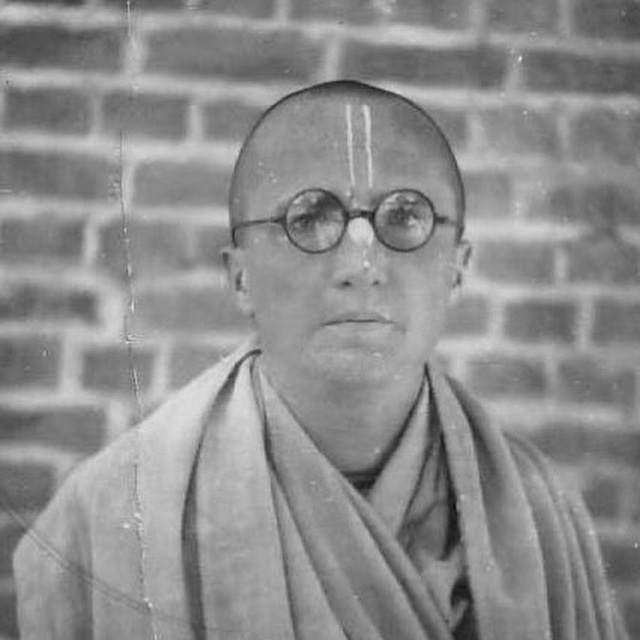
Sadananda was born in Germany in 1908. In the early 1930s, he became a disciple of Shrila Bhaktisiddhanta Sarasvati, a prominent guru and spiritual reformer of Gaudiya Vaishnavism in early 20th century India.
In 1933, his spiritual destiny manifested rapidly when he encountered Swami Hridaya Bon Maharaja in Berlin. This monumental meeting marked the beginning of his connection to the Gaudiya Vaishnava parampara.
Fascinated by the depth of Vedantic philosophy and the sublime path of Bhakti, he followed to London in 1934 and embraced initiation into the path of Krishna Consciousness. He completely surrendered his Western identity for the eternal identity of the soul.
In 1935, Sadananda Das arrived in India, the sacred land of his spiritual master, Shrila Bhaktisiddhanta Sarasvati. Under direct tutelage and divine association, he received his spiritual name and dedicated himself to studying ancient Sanskrit texts.
Following the physical departure of his Guru Maharaja in 1937, Sadananda Das did not waver. Instead, he intensified his personal sadhana, delving into intense study of the Srimad Bhagavatam, the Upanishads, and the Six Gosvamis' literatures.
Through his exemplary life, Sadananda Das proved that Krishna Consciousness transcends all geographical and cultural boundaries. A soul born in Germany became a luminous example of pure Gaudiya Vaishnavism, demonstrating the universal applicability of Sanatana Dharma to the entire world.
Guiding Principles
To systematically propagate the teachings of the Bhagavad Gita and Srimad Bhagavatam, as presented by His Divine Grace Shrila Bhaktisiddhanta Sarasvati, to every individual in Mysore, Karnataka, and beyond — creating an enlightened society grounded in the principles of dharma (righteousness), satya (truthfulness), daya (compassion), and tapas (austerity). Through temple-based programs, educational outreach, cultural festivals, and humanitarian services, the mission aims to demonstrate that spiritual practice is not separate from daily life but is the very foundation upon which a truly progressive, harmonious, and peaceful civilization must be built.
To establish the Gaudiya Mission as a world-class center for Vedic education, spiritual practice, and cultural preservation — a place where seekers from every background, nationality, and walk of life can discover the timeless wisdom of India's spiritual heritage and experience the transformative power of Bhakti Yoga. The long-term vision encompasses the development of a comprehensive spiritual campus featuring a magnificent temple, a Vedic educational institute, a research center for the study of ancient Indian sciences, and a model community that demonstrates the practical application of Bhagavad Gita's teachings in every aspect of human life — governance, economics, education, healthcare, agriculture, and interpersonal relationships.
Core Philosophy
The most fundamental teaching is the distinction between the temporary material body and the eternal spiritual soul (atma). As Lord Krishna declares in the Bhagavad Gita (2.20): "For the soul there is neither birth nor death at any time. He has not come into being, does not come into being, and will not come into being. He is unborn, eternal, ever-existing, and primeval. He is not slain when the body is slain." This understanding forms the bedrock of all spiritual practice and liberates the practitioner from the paralyzing fear of death and the debilitating attachment to temporary material identifications.
Among all paths of yoga described in the Vedic literature — Karma Yoga (the path of selfless action), Jnana Yoga (the path of philosophical knowledge), Dhyana Yoga (the path of meditation), and Ashtanga Yoga (the eightfold yogic system) — Bhakti Yoga, the path of loving devotional service to the Supreme Personality of Godhead, is declared by Lord Krishna Himself as the highest and most direct process of self-realization. "Always think of Me, become My devotee, worship Me, and offer your homage unto Me. Thus you will come to Me without fail." (Bhagavad Gita 18.65). Bhakti is not mere sentiment but a comprehensive science of consciousness transformation that engages every faculty of the human personality in the service of the Supreme.
The chanting of the Hare Krishna Maha-Mantra — Hare Krishna Hare Krishna Krishna Krishna Hare Hare, Hare Rama Hare Rama Rama Rama Hare Hare — is the yuga-dharma, the prescribed spiritual practice for the current age of Kali. Lord Chaitanya Mahaprabhu, the combined form of Radha and Krishna, declared that the holy name alone can deliver complete spiritual perfection. This is not a sectarian proposition but a universal spiritual principle endorsed by scriptures across traditions.
The Vedic scriptures — Bhagavad Gita, Srimad Bhagavatam, Upanishads, Brahma Sutra, and the writings of the Six Goswamis of Vrindavan — serve as the infallible authority for spiritual knowledge. Just as one cannot know the identity of one's father simply by speculation but must hear from the mother, similarly, the supreme truths about God, the soul, and the creation can only be understood through the descending process of revealed knowledge (avaroha-pantha) as transmitted through the disciplic succession (guru-parampara).
The relationship between a bonafide spiritual master (guru) and a sincere disciple is the cornerstone of Vedic spiritual education. "Just try to learn the truth by approaching a spiritual master. Inquire from him submissively and render service unto him. The self-realized souls can impart knowledge unto you because they have seen the truth." (Bhagavad Gita 4.34). Shrila Bhaktisiddhanta Sarasvati, as the transparent via medium of the disciplic succession originating from Lord Krishna Himself, continues to guide millions through his books, recorded lectures, and the institution he founded.
A true devotee of Krishna sees every living entity — regardless of species, race, gender, caste, or nationality — as an eternal spirit soul, a beloved child of God. This vision of universal brotherhood (vasudhaiva kutumbakam) naturally results in compassion, non-violence, and a desire to serve all beings. ISKCON's humanitarian programs, from food distribution to educational initiatives, are practical expressions of this philosophical principle that recognizes the spiritual equality of all souls.

Sacred Verses
ॐ
"Sarva-dharmān parityajya mām ekaṁ śaraṇaṁ vraja
ahaṁ tvāṁ sarva-pāpebhyo mokṣayiṣyāmi mā śucaḥ"
Abandon all varieties of religion and just surrender unto Me. I shall deliver you from all sinful reactions. Do not fear. — Bhagavad Gita 18.66
ॐ
"Man-manā bhava mad-bhakto mad-yājī māṁ namaskuru
mām evaiṣyasi satyaṁ te pratijāne priyo 'si me"
Always think of Me, become My devotee, worship Me and offer your homage unto Me. Thus you will come to Me without fail. — Bhagavad Gita 18.65
ॐ
"Harer nāma harer nāma harer nāmaiva kevalam
kalau nāsty eva nāsty eva nāsty eva gatir anyathā"
In this age of Kali, there is no other means, no other means, no other means for self-realization than chanting the holy name. — Brhan-Naradiya Purana
ॐ
"Patraṁ puṣpaṁ phalaṁ toyaṁ yo me bhaktyā prayacchati
tad ahaṁ bhakty-upahṛtam aśnāmi prayatātmanaḥ"
If one offers Me with love and devotion a leaf, a flower, a fruit, or water, I will accept it. — Bhagavad Gita 9.26